



Baumit International
The customer in focus
There are many points of contact with customers. Baumit International wants to shape all of them in such a way that customers feel well looked after because everything is made as easy as possible for them. This means that not only the employees in direct contact with customers have the needs of the customers in mind, but every single department strives to adapt its procedures, processes and services to customer requirements.
The best way to understand the “Make it simple again!” mission is to put yourself in the customer‘s shoes: What would you expect as a customer? What would pleasantly surprise them or even inspire them? As soon as you see things through the eyes of your customers, you can see where you can still improve. Perhaps a digital application would help you make fewer mistakes and work faster? It always helps to get an overview of your tasks. You take care of the important and urgent things first, and the less important things can be dealt with later.
Customers particularly appreciate it when you are aware of the requests they have made. This can only be achieved if all the departments that the customer comes into contact with work well together and support each other. Baumit International is committed to this and works together across national borders. This is precisely what increases success, says managing director Dorijan Rajkovic. When asked what “Make it simple again!” means for Baumit, he refers to a quote from the famous artist and scholar Leonardo da Vinci.

Keeping things simple
“Simplicity is the ultimate sophistication,” said Leonardo da Vinci, who recognized the importance of simplicity several centuries ago. In today‘s complex world, it is more important than ever to keep things simple. Future market trends such as the shortage of skilled labor and automation show us that we need to make things easier.
The following projects are examples of how the group is increasingly discovering the potential of simplicity for itself.

“At Baumit, we believe that simplicity is the key to effective communication, efficient processes, great products and exceptional customer satisfaction. This mindset helps us to better design our operations and deliver solutions that are simple and easy to implement. The principle of simplicity can be found in all areas of the company. We should strive to overcome obstacles and live by this principle.”
Dorijan Rajkovic,
CEO Baumit International
Marketing & product management
A process that makes innovation easier
The multi-stage Idea2Market process supports innovations from the initial idea to market readiness. It ensures that the needs of our customers are always the main focus. Each phase builds on the previous one, so that step by step an idea becomes a product, solution or new service. The aim of this process is to bring innovations to market faster and more efficiently in all countries – always with a focus on added value for our customers.
Market success begins with an idea
First of all, promising ideas that have the potential for success are selected. Then a specific product is developed from these ideas. As soon as the product is ready, the relevant documents are created, which each country then adapts to its specific requirements. This is followed by training for the sales teams. As soon as the product is on the market, continuous monitoring of its success begins. Here is an overview of the most important steps.
1. Select the innovation
From many ideas, the most promising is selected – it forms the basis for a new product.
2. Develop a product
Here, particular attention is paid to two things: quality and the needs of the customers.
3. Explain the product
Useful and clear documents contain the features, advantages, possible applications and arguments for various customer groups.
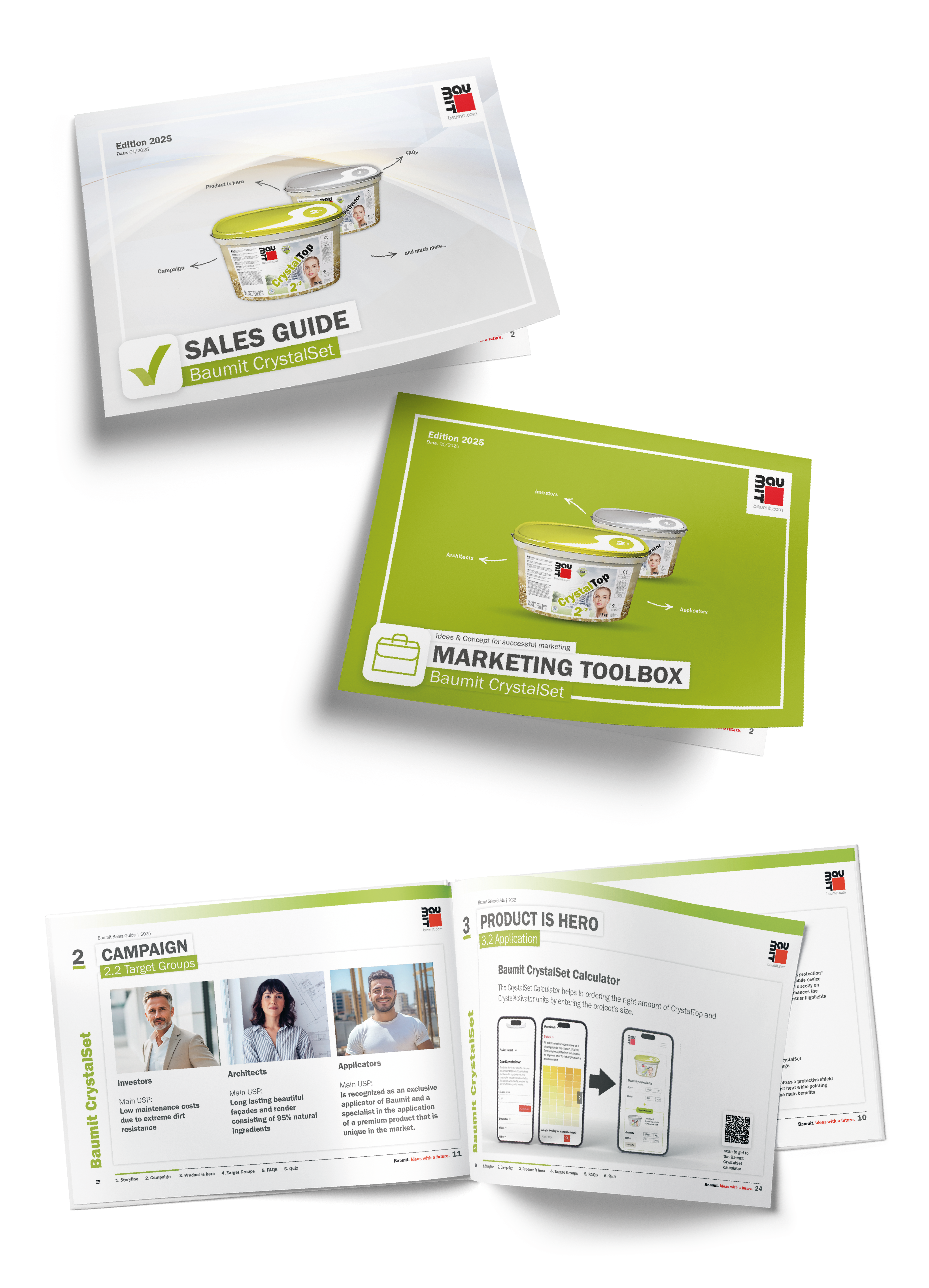
SalesGuide: This brochure (which can also be used digitally) trains the sales team and describes exactly which argument is important for which target group.
Marketing ToolBox: The marketing department in the country receives an overview of the advertising material that it can use: advertisements, brochures, videos and much more. It then selects the appropriate material for its own country.
4. Launch the product on the market
The product will be offered for sale to local customers. Each country will decide for itself how exactly to proceed.
5. Monitor and improve
It is determined how well the product is selling. If necessary, the sales strategy is optimized.
Technical department
Digital platform manages projects from start to finish
The Project Management Center (PMC) provides a complete overview of a project: first the request is submitted, then the project is budgeted, after that it is approved, then the project is managed and finally a report is generated. The major advantage for the Baumit Group is that requests and projects can now be processed in a simple, clear and transparent manner. This also facilitates improved collaboration across national borders.
Everything centrally available instead of stored somewhere
The days of error-prone Excel spreadsheets are over. Scattered files and confusing e-mail correspondence are history. All relevant data and documents are available in one place, providing a good overview of the projects.
Just look it up instead of constantly asking
If you want to check the status of a project, you can do so with just a few clicks. This gives you a quick overview of the project‘s processing status and simplifies coordination between departments and locations.

Real-time improvement status on screen
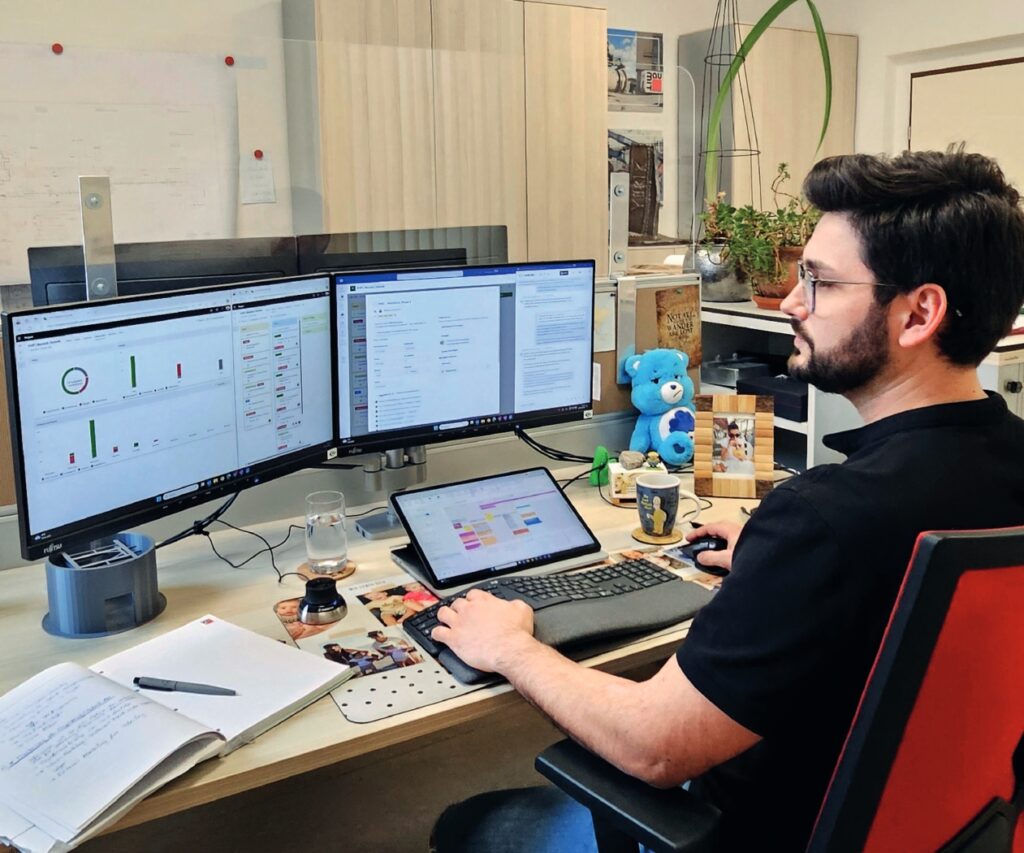
The Baumit technical department has integrated continuous improvement (CIP) into its day-to-day work. The aim is to make internal processes more efficient and transparent. As part of this initiative, a dashboard was created. Like a control center, it provides a clear overview of the status of ongoing improvement measures. This makes the dashboard a central source of information for monitoring progress and goals in real time. An online application was developed for this purpose that, like a control center, shows at a glance which improvements are currently in progress and how far they have progressed. This means that anyone can track progress and goals in real time at any time. Selected improvements are displayed on the dashboard as digital index cards. These contain basic information such as the objective, responsibility, a description, deadlines, progress and a checklist. Related files can be stored and shared. What‘s more, the integration into Microsoft Teams makes it easy to communicate with colleagues.
Many encouraging successes for the collaboration
In order to plan budgets in a comprehensible and error-free manner, standardized templates for cost calculation were developed. A further step was the consolidation of lists and data sources. This streamlined workflows and improved collaboration.
Purchase & sales
Earlier identification of price fluctuations
The purchasing department uses the “cost indicator” application to identify changes in the availability, supply, demand and prices of goods at an early stage. Since the market is constantly changing, it helps to know about changes and their causes in good time in order to react to them in a clever way. The areas of raw materials, merchandise, packaging, transport and energy drive up costs for the company. For example, a 4% increase in labor costs results in a price increase of 0.8%. A 5% increase in transportation costs results in a 0.75% increase. Despite strategic planning, energy cost increases of 5% result in a 0.5% increase. With regularly updated information, market changes can be identified early and the right decisions made.
Negotiate better with suppliers
All national purchasers receive the updated overview every month. This is supplemented by forecasts every quarter. By linking to the internal cost structure, purchasing creates a solid basis for decision-making.

Explain price adjustments more clearly
Customers want to know the reasons for price adjustments. The purchasing department supports the sales department with a clearly structured argumentation guideline to explain these reasons in an understandable way. It explains how changes in costs in areas such as personnel, energy, transport and raw materials influence the price. In addition, specific cost developments for central raw materials such as cement, gypsum or packaging as well as sustainable investments are cited. With this overview, the sales department can explain price adjustments to customers in an understandable way.
Organization
Organizational changes
As of July 1, 2024, Baumit International will be tackling future challenges together even better and is pleased to introduce some new faces and functions that will enrich the International team: Georg Bursik, Managing Director of Baumit Austria, will now also strengthen the area management for Baumit Germany. Christina Casey, who previously managed SIH‘s human resources, will now take over this position for Baumit International as well. Matthäus Safranmüller is the new financial manager. Roman Stickler, head of marketing at Baumit Austria, also has a dual role as head of marketing at Baumit International, a position he has held since the middle of the year. Günter Neubacher is responsible for brand development. Peter Weissmann, with his many years of experience, heads the research and development department and Michael Haindl is in charge of international product management.


