

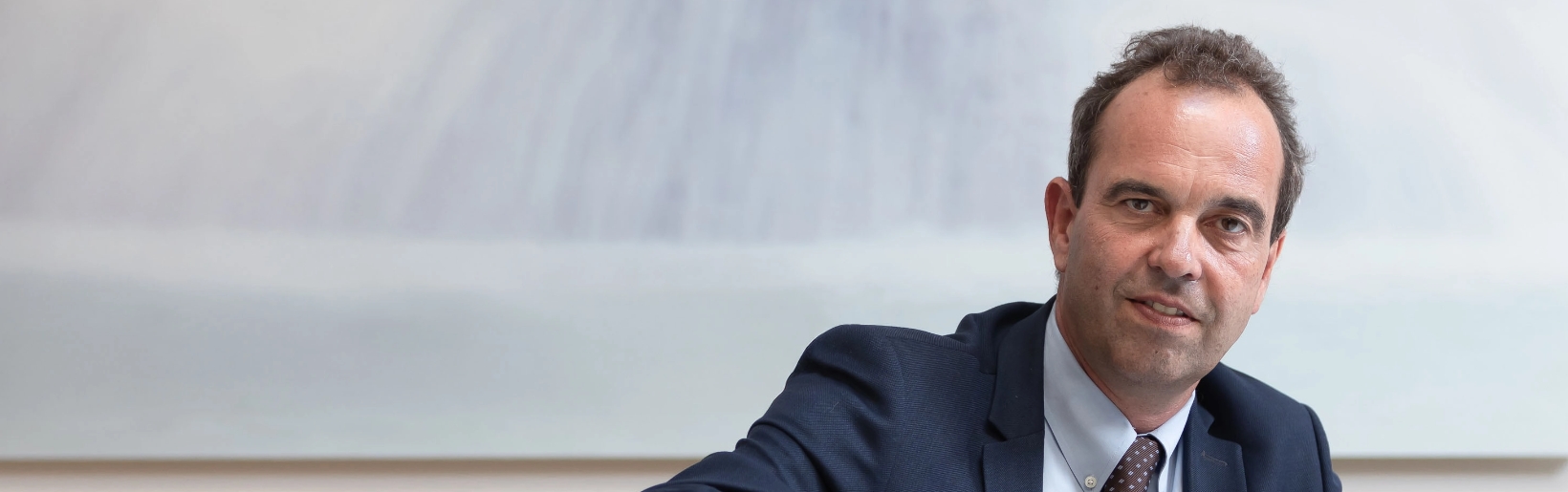
Interview with Robert Schmid
Clear mandate for all
Make it simple again! There is no simpler way to sum up the direction of the entire SIH. But how easy is it to consciously make processes simpler, leaner and thus more efficient again in an increasingly complex working world? And is this message also interpreted similarly by everyone? We asked Robert Schmid personally. Here is an excerpt from the conversation:
“Make it simple again!” That‘s the message you‘re sending to your employees, Mr. Schmid. On the other hand, the world of work is becoming more and more complex. What do you think are the reasons for this?
In an increasingly complex working world, there is a need for specialists who tend to make things even more complicated if you are not careful. Rules and regulations are created and standards defined that, if you question them in detail, cannot all be met without destroying the economy and prosperity.
In an interview in January 2024, you talk about “controllers who control other controllers” – what do you think has gone wrong here?
Apart from the fact that I find this development unreasonable, I see it as mere shifting of responsibility. Who wants to take responsibility for their own actions and decisions today? It is much easier to shift this onto an expert or an auditor or the data protection control. If everyone simply takes on the responsibility intended for them, without any “attempts at shifting”, then everything would be much more pragmatic.
Could you perhaps give a specific example?
Of course. There are many. Just take the new Supply Chain Act, for example. The fact that there is a separate guideline for it shows how an important topic can be made complex. And to make sure everything is done right – here we are back to that unpopular responsibility – these guidelines also contain expert tips and links to more in-depth content.
What does the Supply Chain Act actually regulate specifically?
It regulates the due diligence of companies and obliges them to protect human rights and environmental standards. At the end of the day, it is the same here as in many areas: “crooks remain crooks” and find a way around it. The honest, on the other hand, despair of it.
The current Capital Investments Regulation (KIM) in Austria is a hot topic in this regard. The lending rules are so strict that the dream of building a house remains just that for many, even though they have the start-up capital. What is your view on this?
If the state dictates to banks how they can grant loans and responsible citizens are not allowed to decide how much money they want to spend on their installments, then the only thing that springs to mind is the one thing that explains everything: the shifting of responsibility. Western states tend to regulate things that don‘t need regulating. Fortunately, the KIM regulation is being dropped this year and will not be extended.
You question the usefulness of rules and recommend that your employees do the same. To what extent can I, as a company, disregard regulations?
Of course, you can‘t just ignore regulations. But you should examine each one to see whether it is a “must” or “can” provision. The Austrians and Germans tend to see guidelines as obligations as well.
Automation, digitization, interface management – companies today have various tools at their disposal to make things easier for themselves and their customers. Are tools like these used at SIH and how well are they accepted by employees?
Let‘s start with the topic of digitization. We need it and we can no longer do without it because so much is demanded of us. Another statistic, another graphic. But critical thinking is also needed here. What is it really about? What will help us move forward? This way, we can reduce tasks and tools that really make sense and also make us successful in the future.
Isn‘t digitization also a generational issue?
Of course, it is also a generational issue. The experience of the old hands, who have become successful without digitization, must be combined with the ideas of the young. This is the only way to create the conditions for digitization not just for the sake of digitization, but to push it forward where it makes sense.

“Reducing things is much more difficult than making rules.”
You are an advocate of simplifying things. How simple is it really?
Let‘s take an example from everyday life. Things accumulate over the years. It‘s easier to keep them than to throw them out. It‘s the same in professional life. You have to be able to consciously let go of topics, statistics and activities so that you can work more efficiently and with greater focus.
People like to stick to what they know. Simplifying processes means change. What do your employees make of “Make it simple again!”?
We‘ll start with that right away. Because we are still at the very beginning here, as it was with other topics that are now well established in our corporate culture.
What topics are you addressing here exactly?
A good example of this is the circular economy, i.e. recognizing that waste materials can also be recyclable materials. At the beginning, some people looked at us askance. In many companies, it takes months, sometimes even years, for everyone to understand the meaning of an innovation or a new direction. Once everyone has understood it after quite some time, it is embraced. This is how it is now with us and the circular economy and resource conservation. We know that the Earth‘s raw materials are limited and must be used responsibly so that future generations can also live well. Those who use resources mindfully not only save money, but also reduce emissions. This benefits everyone – and is a real investment in the future. I would even go so far as to say that we are now really good at it. Of course, this acceptance does not happen overnight.
How often do you broach the topic of making things simple in the company?
Over and over again. Just recently at the Christmas party. Of course, we also get puzzled looks from the management level when we say, “Screw the standards!” That‘s a bold simplification of our call, of course. In reality, it‘s about questioning your own actions. Just like the rules that you follow out of blinkered thinking and habit. My approach is: please consider whether an activity is meaningful. If it doesn‘t benefit us, see if you can do without it.
Which brings us back to mucking out – do you have a helpful tip here?
Dinge reduzieren ist viel schwieriger als sie in die Welt zu setzen. Hier kann man nur das regelmäßige Hinterfragen üben. Mit der Zeit bewährt sich diese Theorie. Mit dem Ausmisten gelingt es, Abläufe wieder einfacher zu machen. Wie gesagt, wir sind noch am Anfang. Da muss erst ein Bild bei unseren Mitarbeitern entstehen und auch die Bereitschaft, nicht nur andere, sondern vor allem auch sich selbst und seine gelernten Handlungen zu hinterfragen.
Who is authorized to simplify things at SIH? Who is authorized to point out potential for change? Each and every individual?
Yes, that is my message. And it is directed at each and every one of you. Only those who do a particular job can best judge how it can be simplified. My clear message is: if you feel that something is pointless, discuss it with your superior. If your superior doesn‘t want to hear about it in the first instance, then please don‘t give up straight away, but keep at it. We don‘t do pointless things.
Taking responsibility instead of doing things in a blinkered way is the message. So what questions should your employees ask themselves regularly?
A very simple question, but one that keeps coming up: Why do we need this?
One last question: “Make it simple again!” or MISA for short. Is this a pipe dream or a reality at SIH?
Above all, my goal is to raise awareness and encourage all SIH employees to critically question things on a regular basis. Don‘t be fooled by supposed complexity – not everything that seems complicated is automatically sensible or intelligent. The need of the hour is to embrace simplicity! So, together, let‘s make it simple again!
